
War-Torn Westphalia
Westphalia has experienced significant turmoil throughout the centuries, which exponentially surpasses the scope of this website. However, a quick summarization of applicable conflicts is beneficial in order to gain insight into the overall landscape because one of the main catalysts for Ferdinand and Henry’s emigration was the constant threat of war.
Thirty Years’ War [1618-1648]
The Thirty Years' War (1618-1648) was a devastating European conflict, starting as a religious clash between Catholic and Protestant states within the Holy Roman Empire but evolving into a broader power struggle, ending with the Treaty of Westphalia, which redefined European politics, weakened the Emperor, established state sovereignty, and shifted power towards France and Sweden. It devastated Central Europe, causing immense casualties from battles, famine, and disease, and marked the end of major religious wars in Europe, ushering in the modern nation-state system.
*This war is directly linked to massive losses of church records, especially parish registers (church books), due to widespread destruction by warring armies, deliberate destruction, neglect, and displacement, creating huge gaps for genealogists and historians today.
Seven Years War [1756-1763]
The Seven Years' War (1756-1763) was a global conflict, known in North America as the French and Indian War, fought between Great Britain and France (with allies) for colonial dominance, especially over North America and India, while in Europe, Prussia and Britain clashed with Austria, France, Russia, and Sweden over Silesia. Britain emerged victorious, gaining Canada and all French territory east of the Mississippi River, solidifying its global power, but the massive war debt led to heavy taxation on American colonists, sparking unrest and contributing to the American Revolution.
Kingdom of Westphalia [1807-1813]
The Kingdom of Westphalia (1807-1813) was a short-lived Napoleonic satellite state in Germany, ruled by Napoleon's brother Jérôme, featuring progressive but often burdensome French-style reforms like a modern constitution, abolition of serfdom, and Jewish emancipation, funded heavily by taxes and troops for French wars, ultimately leading to its collapse and absorption by Prussia after Napoleon's defeat, though many reforms endured.
Second Schleswig War [Danish War] [1864]
The Second Schleswig War (1864) was a conflict between Denmark and a Prussian-Austrian alliance over the German duchies of Schleswig, Holstein, and Lauenburg, sparked by Denmark's attempt to incorporate Schleswig, violating prior treaties. Outnumbered and outgunned, Denmark was decisively defeated, ceding the duchies to Prussia and Austria in the Treaty of Vienna. The war solidified Prussia's power, intensified German nationalism, foreshadowed German unification, and became a national trauma for Denmark, ending its ambitions in the region.
Austro-Prussian War [Seven Weeks' War] [1866]
The Austro-Prussian War [Seven Weeks' War, 1866] was a swift conflict where Prussia defeated Austria and its German allies, establishing Prussian dominance over the German states, dissolving the German Confederation, and paving the way for German unification under Prussia's leadership. Driven by Otto von Bismarck's ambition, the war showcased Prussian military superiority (railways, breech-loading rifles) at battles like Königgrätz, excluded Austria from German affairs, and led to the formation of the North German Confederation, shifting European power dynamics.
Franco Prussian War [1870-1871]
The Franco-Prussian War was fought between France and what is now Germany between 1870 and 1871, with Germanic states emerging victorious. The war was provoked by Otto von Bismarck, who strategically planned the whole thing with the ultimate goal of bringing about a unified Germany.
World War I [1914–1918]
World War I (1914-1918) was a devastating global conflict between the Central Powers (Germany, Austria-Hungary, Ottoman Empire) and the Allies (France, Britain, Russia, U.S., etc.), triggered by European rivalries and the assassination of Archduke Franz Ferdinand, leading to unprecedented trench warfare, new deadly weapons, and millions of casualties, ultimately ending with the Central Powers' defeat, redrawing maps, and setting the stage for WWII.
World War II [1939-1945]
World War II (1939-1945) was the deadliest conflict in history, pitting the Allied Powers (led by the U.S., U.K., Soviet Union, China) against the Axis Powers (Germany, Italy, Japan) in a global war sparked by Nazi Germany's invasion of Poland. The war saw massive destruction, the Holocaust, strategic bombing, and the first use of nuclear weapons, ending with the Axis defeat and the emergence of the U.S. and Soviet Union as superpowers, leading to the Cold War.
In 2025, Franz Josef shared some memories from this time period as he was 10 years old when the war ended:
During the war, he recalled times when tanks were driving through and planes were flying/fighting above the grain fields.
The spent metal ammo belts would plummet to the ground and the children made a game out of finding the longest intact sections. He also recalled a time of an allied soldier spending days in the hay loft and using it as an elevated lookout point.
Although the war ended in Europe in May 1945, the danger was far from over.
Russian soldiers/prisoners were making their way back home and no one had food, so there was a lot of looting. The Lusebrink family hand picked locals to come live in the 1920 house on the farm as there was safety in numbers and they wanted to fill the house with like minded people before unsavory people started showing up trying to force entry. Wooden lids/barriers were constructed to close off the tops of the staircases during the night. If anyone managed to get into the basement and/or ground floor, they couldn’t easily access the floors above.
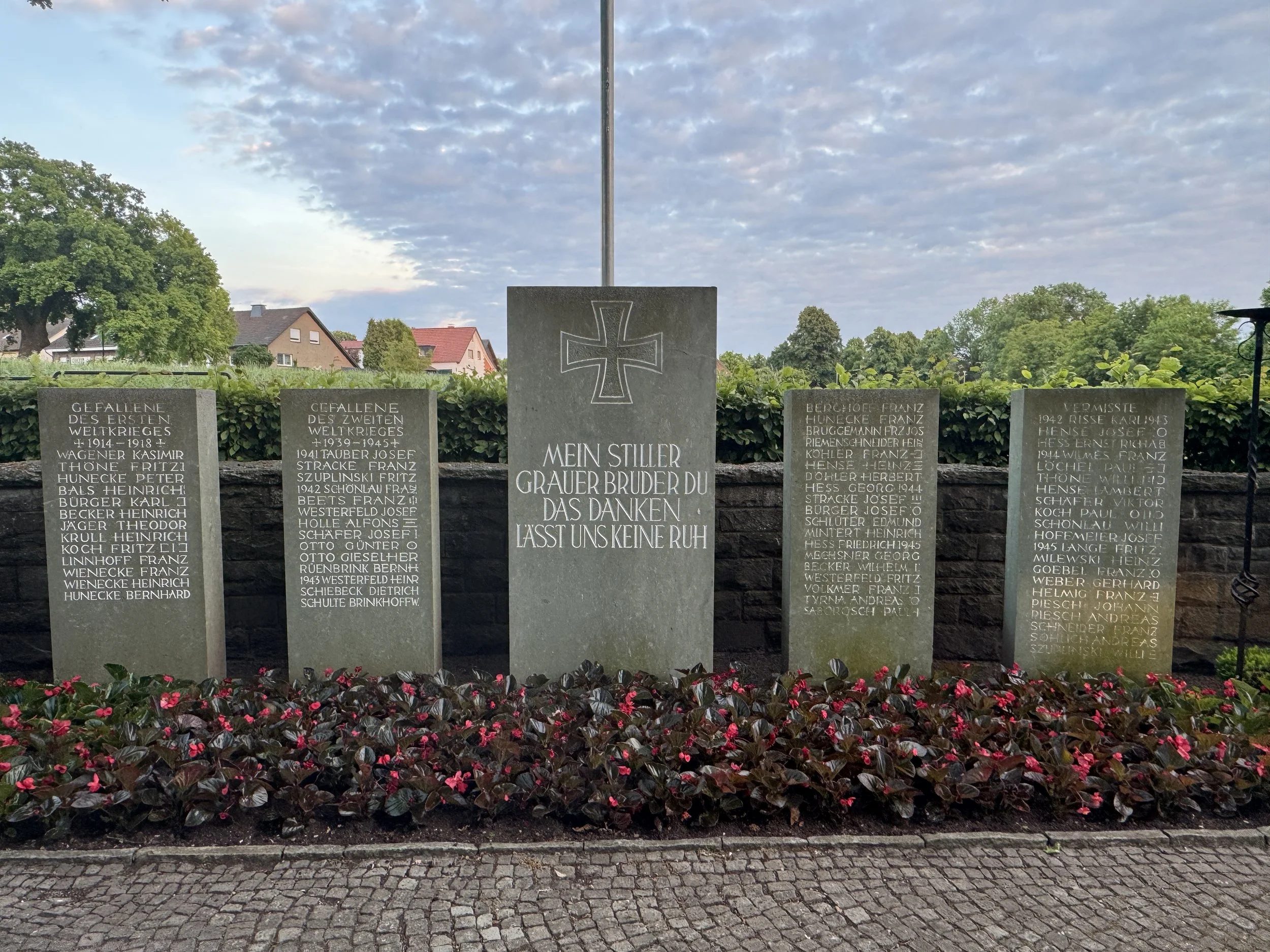
WWI Memorial in Schmerlecke, Germany
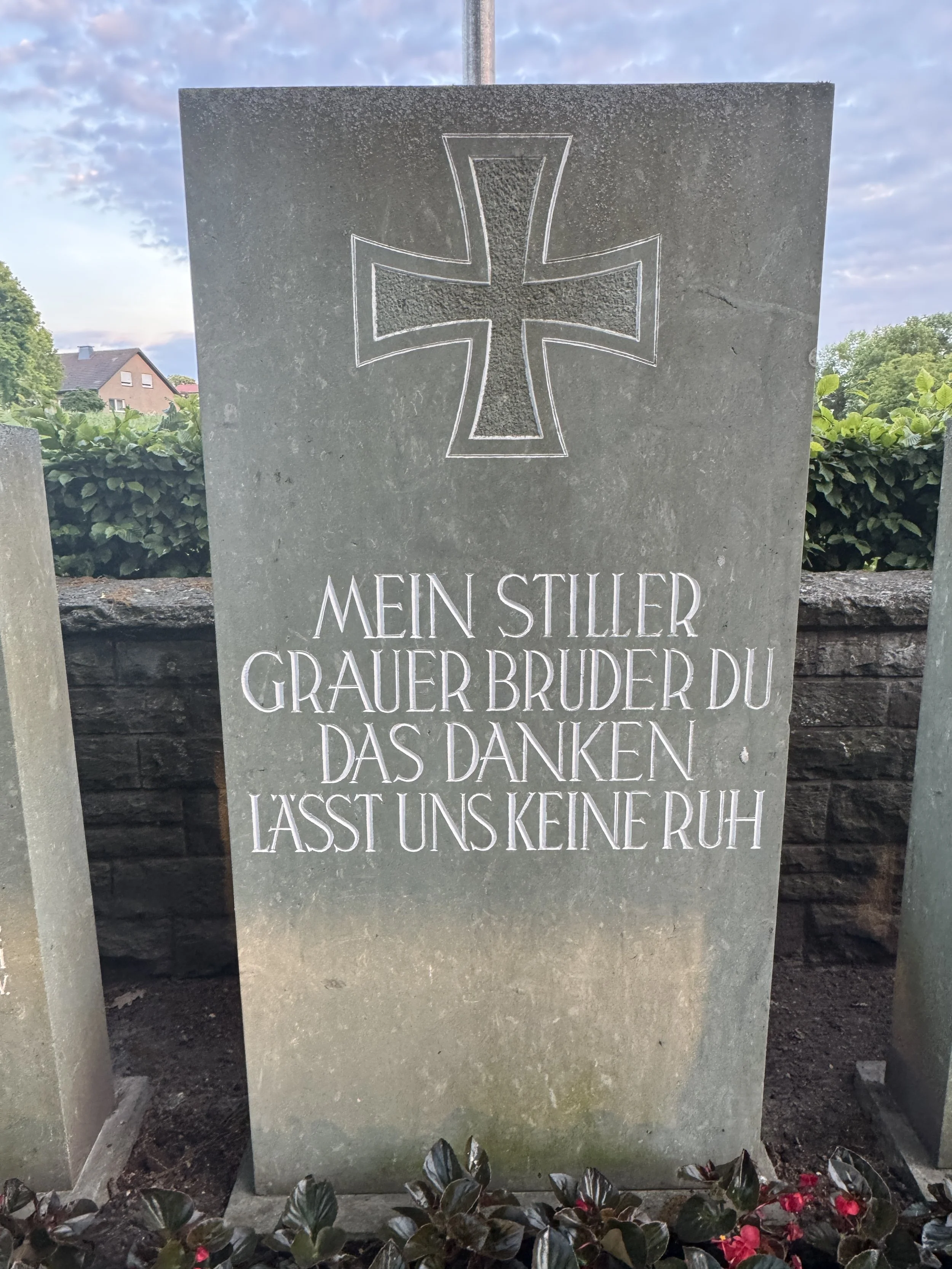
“My silent gray brother your gratitude gives us no peace”
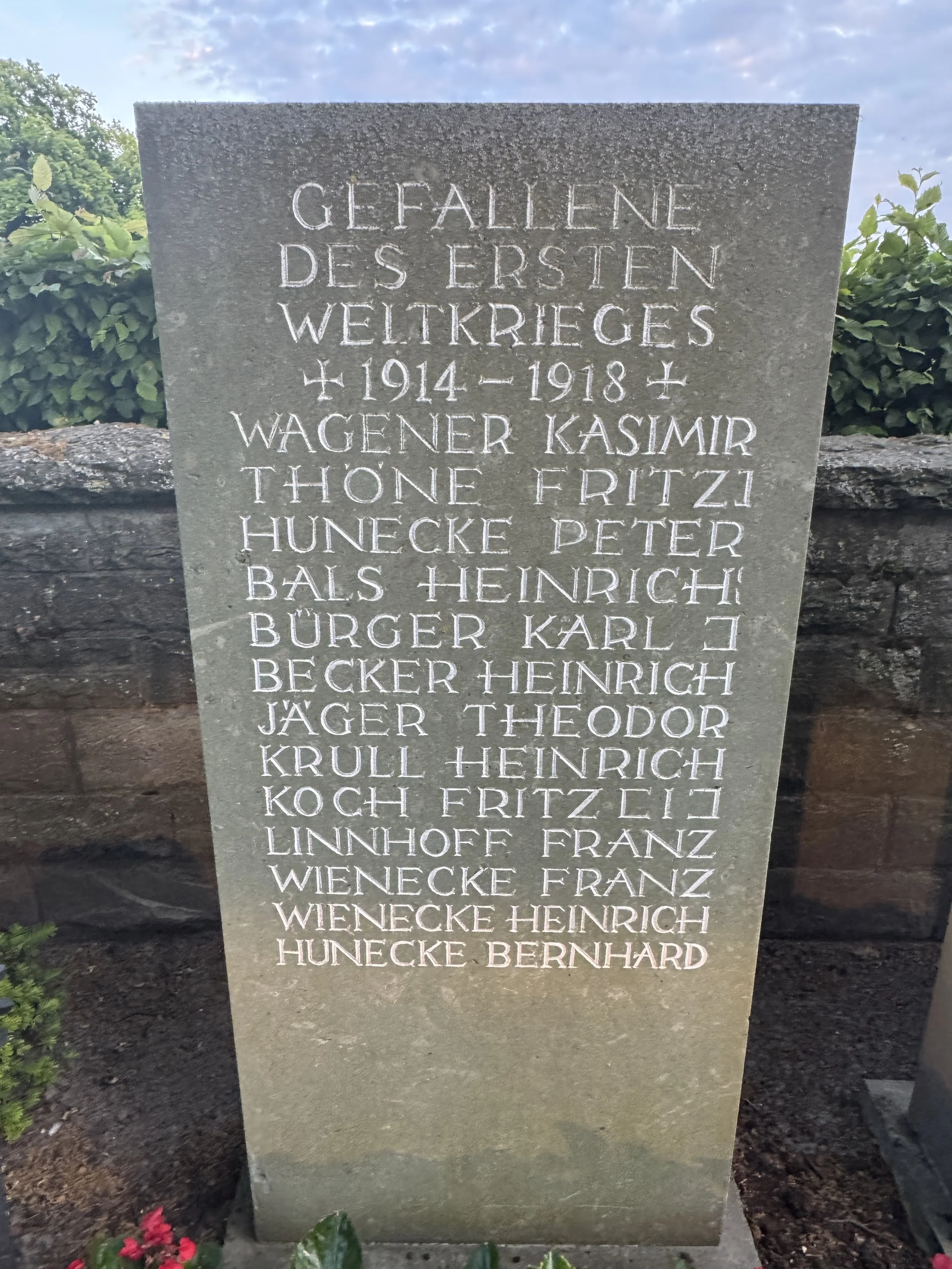
Heinrich Bals 03 December 1915 - 06 December 1915
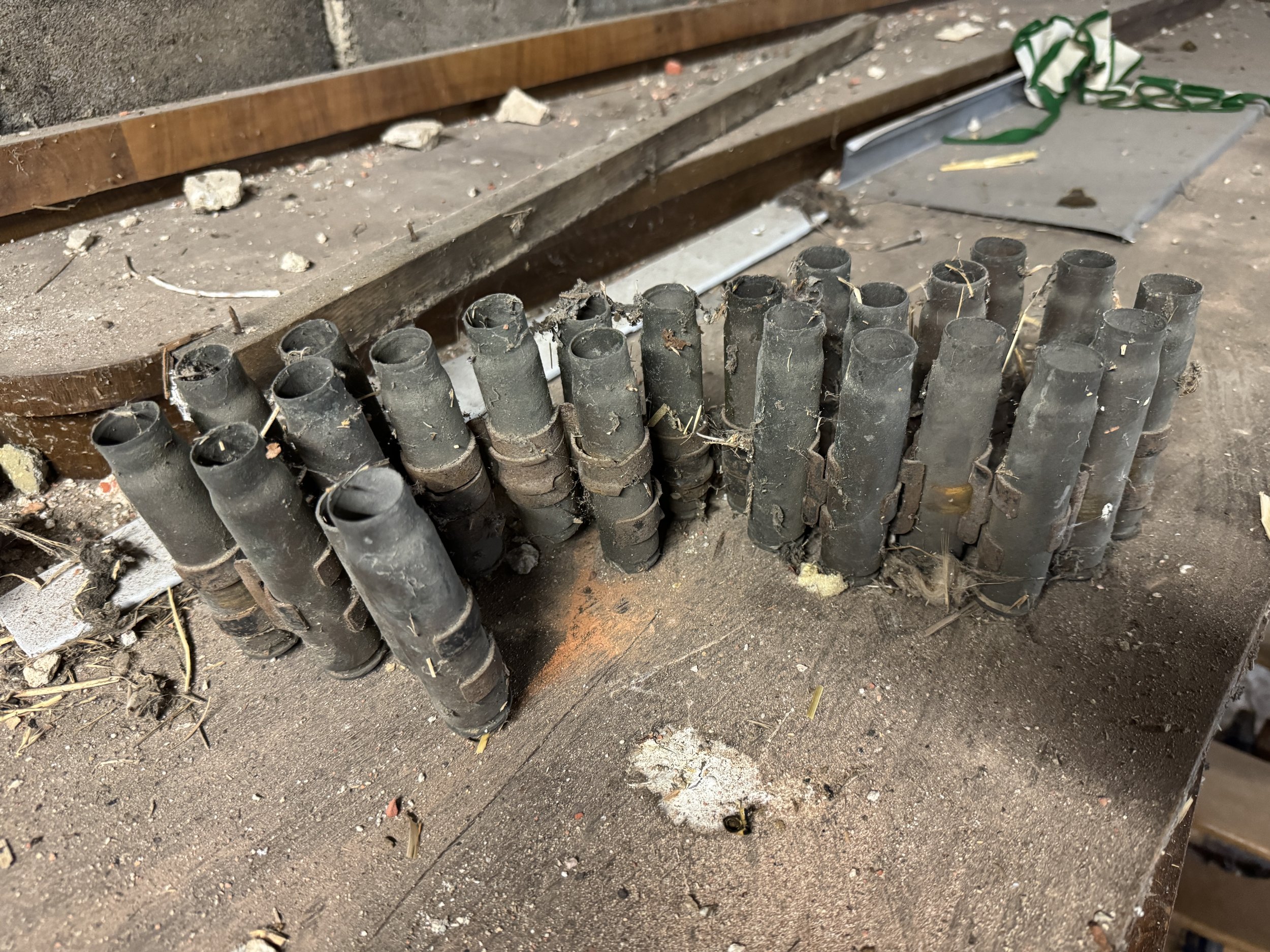
WWI Airplane Ammo Chain
Sources
Google AI:
Historical synopsis of Prussian Military conscription