
The Village of Schmerlecke


In the name of God, the Lord and Savior Jesus Christ. Louis, by God's providence, Emperor and Ruler. It is the custom of the Imperial Majesty to honor and exalt your faithful followers with manifold gifts and tremendous honors. Therefore, following the custom of our parents, namely our royal ancestors, it has pleased our Majesty to honor our faithful, named Rhidac, with certain objects of our property and to transfer into the power of his right the grace of our benevolence. Therefore, may the insight and conscientiousness of all our faithful followers, both living and future, recognize that we have transferred to him, as property, objects of our possession, located in the Bructerergau in a village called Ismereleke, namely 3 hectares with the cultivated and undeveloped land and the associated forests; likewise, in the same district, in a village called Anadopa (Ampen), 2 hectares with the cultivated and undeveloped land and the associated forests.
Therefore, by this document, we cede the said farms, with all their appurtenances, as contained above, to the said Rihdag, our faithful, as his property, and transfer them, by our right, into his right and possession by a solemn donation, in such a way that whatever he decides to do from this day forward, by virtue of his right of ownership, from these farms and from all that clearly belongs to them by law, he shall act with free and unlimited authority. And so that this proof of our generosity and donation retains lasting validity, we have had this document sealed hereunder with our own hand and with the imprint of our ring.
Sign (L.M.) of Louis, the Most Exalted
I, Hirminmaris, notary, have written this in place of the Theton.
Given on April 1, in the 20th year of the reign of Lord Louis, the Most Exalted Emperor, in the 11th Indiction.
Proceeded in the city of Worms, in the name and blessing of God. Amen.
Translation by Dr. Lappe local historian
The village of Schmerlecke is first documented in 833. It is part of a deed gift from Emperor Louis the Pious to a Count Rhidac, a nobleman who remained loyal to him during a period of civil war involving Louis’ three sons. Count Rhidac transfers the property to the Meschede Monastery circa 860.
This document is preserved in The Westphalia Division of the Landesarchiv Nordrhein-Westfalen [Former State Archives in Münster]. I have provided pictures of the front and back of the document as well as an English translation.
Historical News About the Parish and Monastery of Benninghausen mentions Schmerlecke multiple times in regard to land acquisitions in the 1300s. The publication is in German, but once I get it translated, I’ll be able to post pertinent information.
My current assumption is that Schmerlecke remains within ecclesiastical ownership from 860 until eary 1800s. I’m unsure of exactly when and how independence from the Benninghausen Monastery was gained, but it became a district of Erwitte on January 1st, 1975.
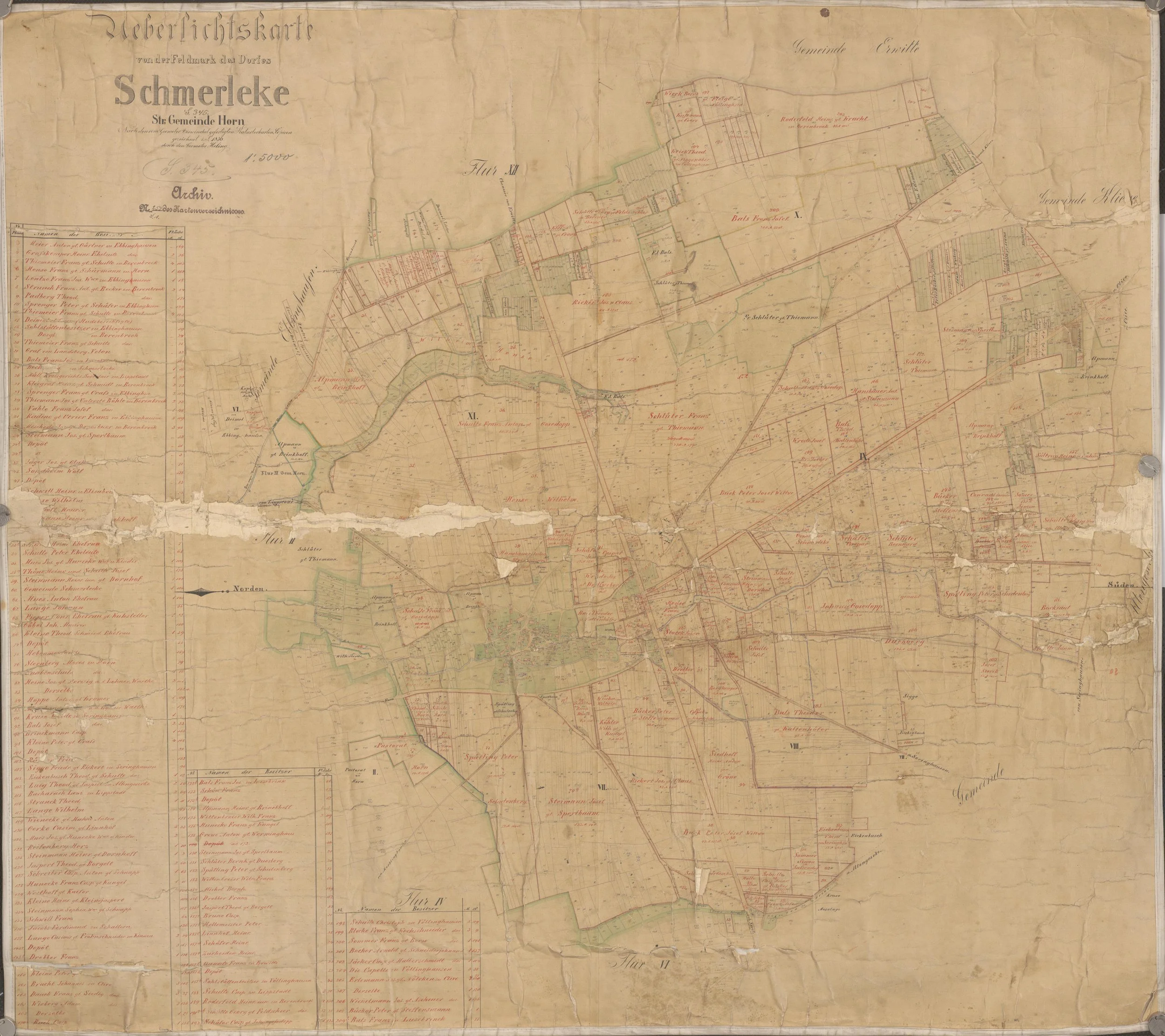
Below I’ve included two maps of Schmerleke - one from 1828 and another from 1856.

Modern Schmerlecke
The village of Schmerlecke is characterized by an agriculturally structured district north of the B 1 and newer residential areas - the so-called Kleefeldsiedlung - and commercial enterprises south of the B 1.
The gently rolling farmland is divided by several waterways—the Jülmecke, Trotzbach, and Ahe—with their flanking vegetation. The old village center is located in the area of the "Schmerlecker Dorf" street. The street layout, bordered by quarry stone walls and stately agricultural buildings, vividly conveys the historical building and street layout.
Schmerlecke's landmark, visible from afar, is the windmill south of the B1, which was built in 1831. Schmerlecke also includes the St. Antonius Chapel, which belongs to the parish of Horn.
The town is adorned with an exemplary renovated town center, a modern community center, and a sports facility, all designed as part of the village renewal program.
Population: 686 inhabitants (as of December 31, 2021)
Local Mayor: Mario Bussmann
Sightseeing features
Chapel of St. Anthony; wayside shrine opposite the chapel
Half-timbered farmhouse, Schmerlecker Dorf 24
Half-timbered farmhouse, Schmerlecker Dorf 39
Half-timbered house, Soester Straße 384; windmill;
Cast iron wayside cross, Windmill Way
Farmhouse with granary, Breienweg 30
Farmhouse with granary, Zur Wormei 7
Farmhouse, Schmerlecker Dorf 50
Farmhouse, Schmerlecker Dorf 18
Distillery with factory owner's villa, Schmerlecker Dorf 26 [Siedhoff Distillery]
Sources
The Westphalia Division of the Landesarchiv Nordrhein-Westfalen:
833 document images
1856 map of Schmerlecke
1150 Jahre Schmerlecke 883-1983:
833 document German translation which was then translated to English using Google Translate
1828 map of Schmerlecke